
सञ्चित
Sañcita
The accumulated
In brief
The sum of all impressions from this life and from earlier ones that have not yet come into effect. The largest part of the store.
Image
The grain in the store
Wiki · yoga knowledge
Action and effect
Karma (karma · कर्म) literally means “action”. In yoga it means the action and its effect at once: what we do, think and say leaves traces, and those traces shape what we experience. On this page you can learn what karma means, whether there is good and bad karma, why yoga is not about collecting it, and what remains when no karma is left.
What it means
The Sanskrit word karma (कर्म, stem karman) comes from the root kṛ, “to do, to make, to act”. Literally, karma is therefore simply the action. In the oldest texts, the Vedas, it meant above all the ritual act, the sacrifice. Since the Upanishads the term widens: karma is every action in thought, word and deed, together with the effect it leaves behind.
The Brihadaranyaka Upanishad puts it in one sentence: As one acts and as one walks, so one becomes. Whoever does good becomes good; whoever does bad becomes bad. Karma is therefore not a judgement from outside but a law of cause and effect: every action shapes the one who acts and lays the ground for what they experience later.
In the Yogasūtra, Patañjali describes how that happens: actions leave impressions (saṁskāra) in the mind. These gather in the Karmāśaya, the “storehouse of karma”, and little by little ripen into experiences, pleasant and unpleasant alike (Yogasūtra 2.12 to 2.14). Their root is the Kleśas, the five causes of suffering: ignorance, the sense of I, desire, aversion and clinging to life.
White, black, mixed
Yes and no. Patañjali distinguishes three kinds: white karma from wholesome actions, black from harmful ones and mixed, which prevails in most people. White karma ripens into pleasant experiences, black into painful ones. That far, the picture of good and bad holds.
What matters, though, is the sentence that follows: for the yogi, karma is neither white nor black (Yogasūtra 4.7). Because white karma binds too. It brings pleasant fruits, but it keeps us in the cycle of acting, experiencing and rebirth (saṁsāra) just as the black does. A golden chain is still a chain. In yoga, therefore: doing good, yes. But not in order to accumulate something by it.
Yogasūtra 4.7 · karmāśuklākṛṣṇaṁ yoginaḥ · trividham itareṣām
Store, harvest, seed
The Vedānta tradition divides the storehouse of karma by its ripeness. The image for it is the farmer: he has grain in the store, grain in the field and grain he is sowing right now.
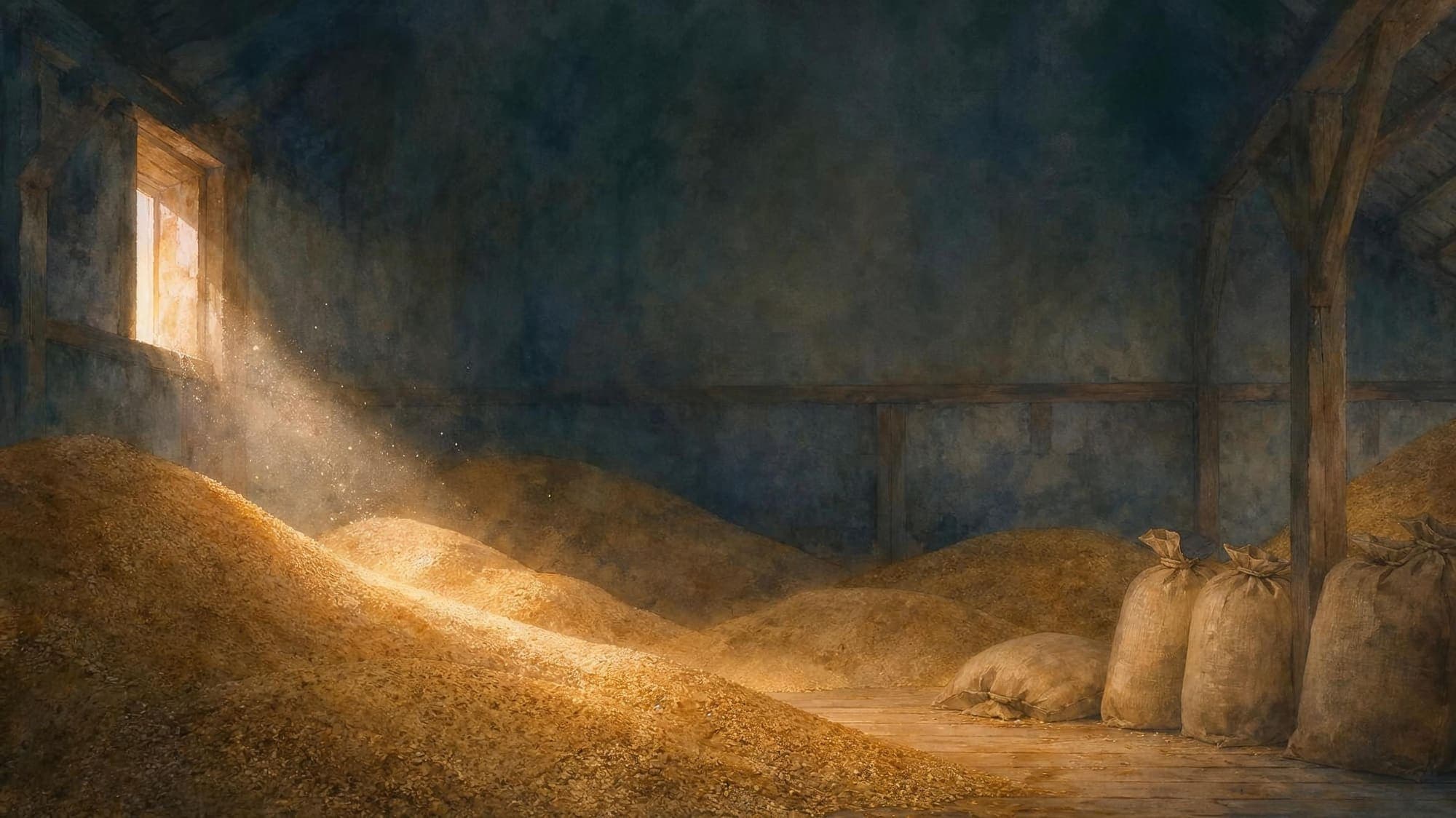
सञ्चित
The accumulated
In brief
The sum of all impressions from this life and from earlier ones that have not yet come into effect. The largest part of the store.
Image
The grain in the store
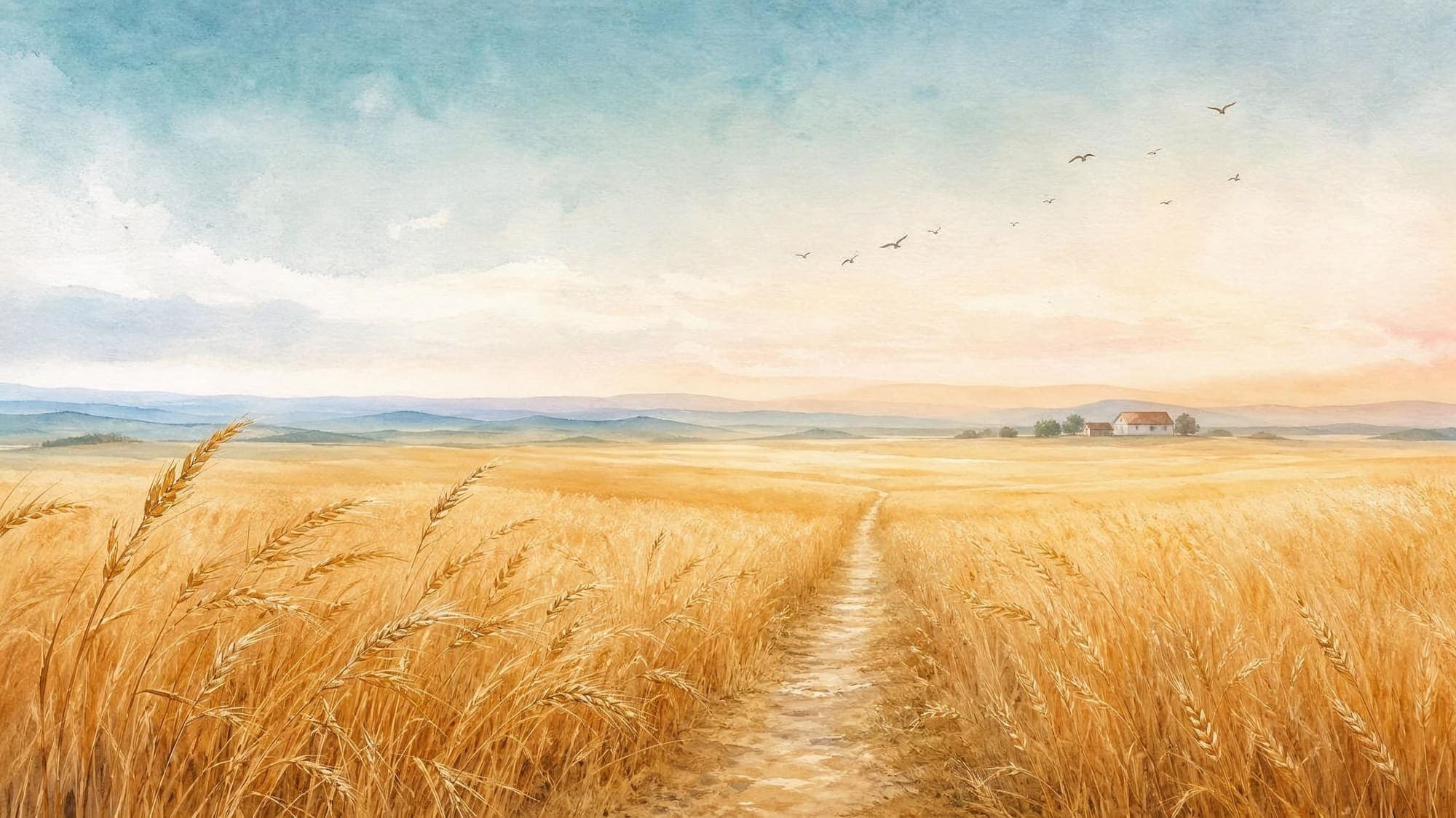
प्रारब्ध
The begun
In brief
The part of the Sañcita that ripens in this life: body, family, circumstances, encounters. What has begun runs its course like an arrow that has left the string.
Image
The grain in the field
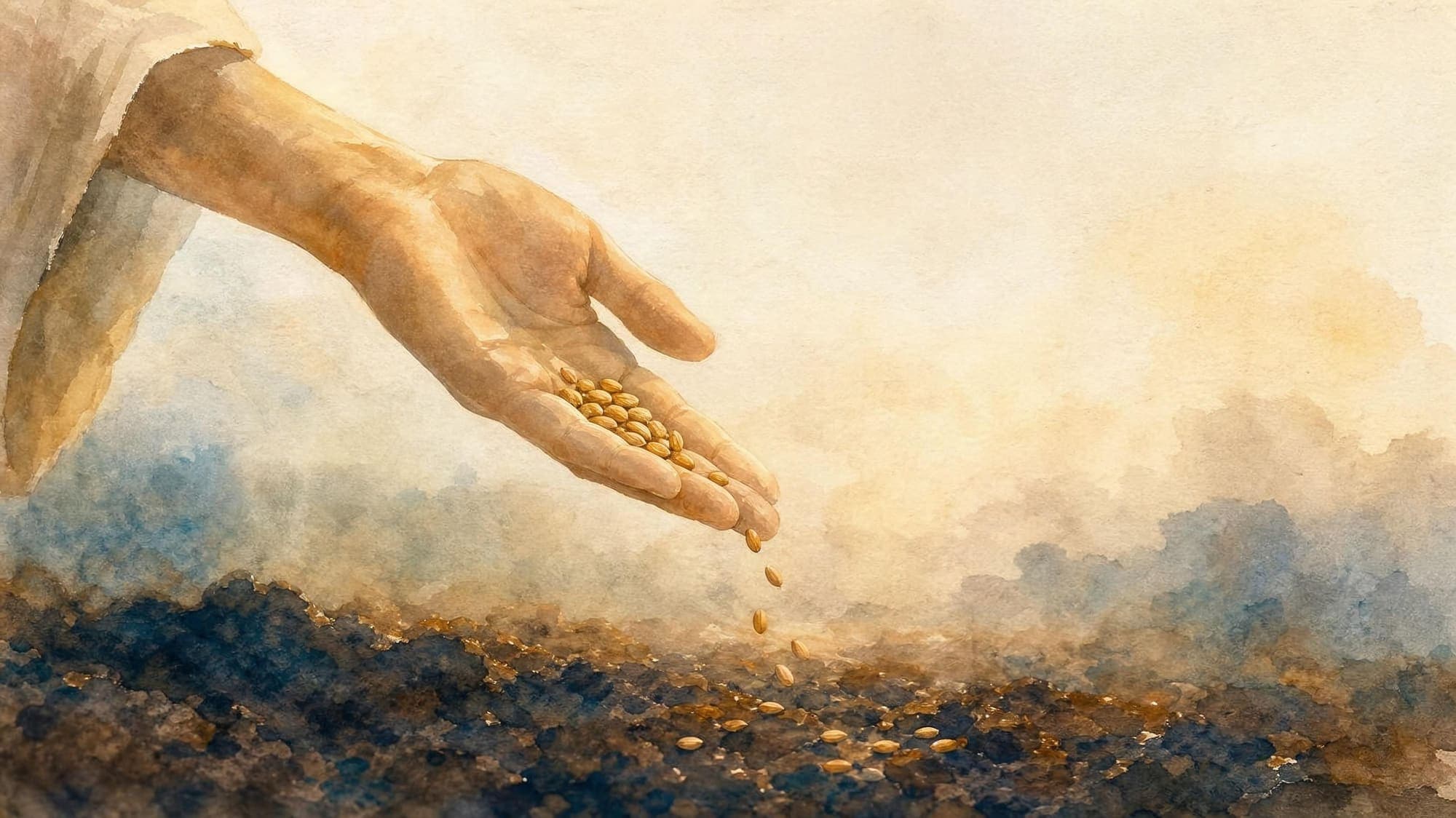
आगामि
The coming
In brief
The karma we are creating anew right now through our actions, also called kriyamāṇa. It flows back into the store. This is where our freedom lies.
Image
The grain we sow
A misunderstanding
When we speak of karma today, we usually mean a kind of “account”: good deeds pay in, bad ones are debited at some point, and when something happens to someone, we say with a smile, “That was karma”. The picture is understandable, because it makes life fair and manageable. The teaching of yoga, however, means something else:
Often heardKarma rewards and punishes.
In yogaKarma does not judge. There is no judge handing out points. An action takes effect the way a seed sprouts: after its kind, not by merit.
Often heardKarma works at once.
In yogaSome fruit ripens in this life, some much later. What happens today is mostly the harvest of seed sown long ago (Prārabdha).
Often heardThe more good karma, the better.
In yogaGood karma binds to the cycle too. The goal is not a full account but an empty store: less karma, not more.
Often heardKarma is fate, so there is nothing I can do.
In yogaWhat has begun runs its course, but what is to come arises anew in every moment. How we answer our Prārabdha lies in our hands.
The way the Bhagavad Gītā shows is called Niṣkāma Karma, acting without desire: “Your claim is to the action alone, never to its fruits” (Gītā 2.47). The fruit (phala) is the result of an action: success or failure, praise or blame, reward or loss. “Pulling at the fruit” means already clinging inwardly to the result while acting, wishing it near or fearing it. It is exactly this clinging, not the action itself, that leaves the impression in the storehouse of karma; for it springs from desire and aversion, two of the Kleśas. Whoever acts because it is right, and lets go of the result, sows no new karma. That is the core of Karma Yoga.
Beyond yoga
Suffering, desire and selfless action occupy not only yoga. Other traditions arrive at related answers, often with a different emphasis. Choose on the left what interests you.
Buddhism
Buddhism arose in the same India as yoga and shares with it the term karma (Pali kamma). The Buddha, however, shifts the emphasis: “It is intention, monks, that I call karma” (Aṅguttara-Nikāya 6.63). It is not the outer deed that leaves its mark but the state of mind it comes from. The tradition names three roots of each:
The Four Noble Truths circle around suffering (dukkha) and its cause, craving and clinging (taṇhā). That is very close to the Kleśas of yoga. The path is alike too:
In Buddhism this way is called the Eightfold Path; in yoga it is the eight limbs.
The great difference lies in the self. Yoga knows the Ātman, the unchanging self that frees itself from karma. Buddhism teaches non-self (anattā): there is nobody who “has” karma. The impressions condition one another like a flame passed from candle to candle without anything crossing over. The goal is called Nirvāṇa, the extinguishing of greed, hatred and delusion. The way there is compassion (karuṇā) and loving kindness (mettā), not the accumulation of merit.
Jainism
Nowhere is karma taken as literally as in Jainism. Here karma is subtle matter that is bound to the soul (jīva) through actions born of passion and makes it heavy and dull, the way dust clings to a damp cloth.
The way has two sides:
Once the soul is free of all karma, it rises of its own accord and rests in omniscience (kevala).
For yoga, Jainism matters because its ethics echo in Patañjali's Yamas: Ahiṁsā stands first there. And the image of karma that weighs down the soul and wants to be worn away makes it vivid why yoga is about less and not about more.
Sikhism
Sikhism, which arose in the Punjab in the 15th century, takes karma and rebirth over from its Indian surroundings. The Guru Granth Sahib describes how a person receives, through their actions, the body they wear. Liberation, however, does not come through karma alone but through grace (nadar): the glance of God, who turns towards the one who opens up to him.
In practice, three pillars stand at the centre:
The open kitchen of the Sikh temples, where everyone eats for free regardless of origin and faith, is Karma Yoga lived: work without an eye on reward.
Christianity
“Whatever a person sows, that they will reap” (Galatians 6:7) sounds like karma, and the Sermon on the Mount knows acting without an eye on the fruit (Matthew 6):
Whoever does good in order to be seen, says Jesus, has already received their reward.
The core difference lies in grace. In Christianity, salvation is not earned but given; Paul sets it expressly against “works”. That is the answer to collecting points from another direction: not because good karma binds too, but because no account could ever be full enough before God. Both ways end at the same place: doing good without keeping count.
Christian mysticism goes one step further. Meister Eckhart speaks of Gelassenheit, letting be: acting “without a why”, out of the ground of the soul, without self-will and without any aim at reward. That stands very close to Niṣkāma Karma.
Stoa
The Greek and Roman Stoa knows no karma, but it knows the question of action and fruit. Epictetus opens his handbook with a distinction:
Whoever hangs their happiness on the second becomes unfree; whoever founds it on the first becomes free.
That is Gītā 2.47 in Greek dress: “Your claim is to the action alone, never to its fruits.” The Stoic does what is right with full strength and accepts the result as it comes. The image for it is the archer: he aims as well as he can; whether the arrow hits, the wind decides too.
Prārabdha too has a Stoic sister: amor fati, accepting what has begun and can no longer be changed, without forgetting the freedom in the next step over it.
Daoism
Chinese Daoism does not speak of karma, but it asks the same question from the other side: not “How do I become free of the consequences of my actions?” but “How do I act so that I never work against the current in the first place?” The answer is called Wu wei (無為), literally “non-doing”. What is meant is not inactivity but acting without forcing, without tensing up, without pushing the I to the front.
The Daodejing (chapters 2, 37, 48, 63) describes the sage like this:
The images for it are water, which forces nothing and yet hollows out the stone, and the farmer who does not pull the grain up by the stalk but creates the conditions and lets it grow. Wu wei is the art of doing what is needed at the right moment and then taking the hand away.
There are two bridges to karma:
Resisting what is costs strength and creates new entanglement; going along with it frees the hands for what is due now.
In everyday life, Wu wei often shows itself as the opposite of what we have learned:
That is neither passivity nor indifference: the Daoist sage does a great deal, but he does not wear himself out on the result. In coaching we pick this up when it comes to control, letting go and dealing with what cannot be changed.
The way
Because the storehouse of karma is rooted in the Kleśas, yoga starts there: whoever weakens ignorance, the sense of I, desire and aversion creates less new karma. The eight limbs of yoga are there for exactly that: ethics in action, practice with body and breath, collectedness of the mind.
The accumulated is disarmed through insight. The tradition's image is the roasted seed: it looks as before, but it no longer sprouts. For whoever recognises that they are not body, role and thought, the old impressions no longer ripen into new bondage.
Only what has begun, Prārabdha, remains: the arrow that has left the string flies to its end. That is why even the liberated live out their lives with illness, age and death. The difference is that they no longer cling to it.
With us in practice

The goal
Then the cycle ends. The tradition calls this state Mokṣa, liberation, or with Patañjali Kaivalya, the pure being-for-itself of consciousness. Whoever sets no new impressions and whose old impressions no longer sprout is not reborn. The Yogasūtra puts it briefly: from this follows the ceasing of the Kleśas and of karma (4.30).
That does not mean a liberated person does nothing any more. They go on acting, eating, speaking, teaching, helping. Only their actions leave no trace any more, because no I pulls at them and no expectation hangs on them. Their karma is neither white nor black. The image for it is the potter's wheel: the potter took the hand away long ago, and the wheel keeps turning for a while on its own momentum until it comes to rest by itself.
Whether you believe in rebirth or not: the thought carries in the here and now as well. A life with less karma is a life with less attachment, less calculating, less “What do I get for it?”. What remains is the action itself, and the freedom in it.
Patañjali describes the way there in the eight limbs of yoga; of Ātman and Brahman, which stand behind it, the Upanishads tell.
Acting without pulling at the fruit.
Related topics
On the mat, in singing and in coaching you practise staying in the doing instead of pulling at the fruit. That is how reading becomes experiencing.