Concentration
Attention rests on the movement being carried out right now.
Wiki · yoga knowledge
Yoga and Pilates: what they share and where they differ
Yoga and Pilates can both involve conscious movement, breath and concentration. Their backgrounds differ, though: Pilates is a movement method in its own right, developed in the 20th century. Yoga has its roots in Indian traditions and can reach far beyond physical exercise.
In brief
Pilates is a movement method that Joseph Pilates (1883–1967) developed in the first half of the 20th century. He himself called it “Contrology”, by which he meant movement that is consciously guided and carried out with control.
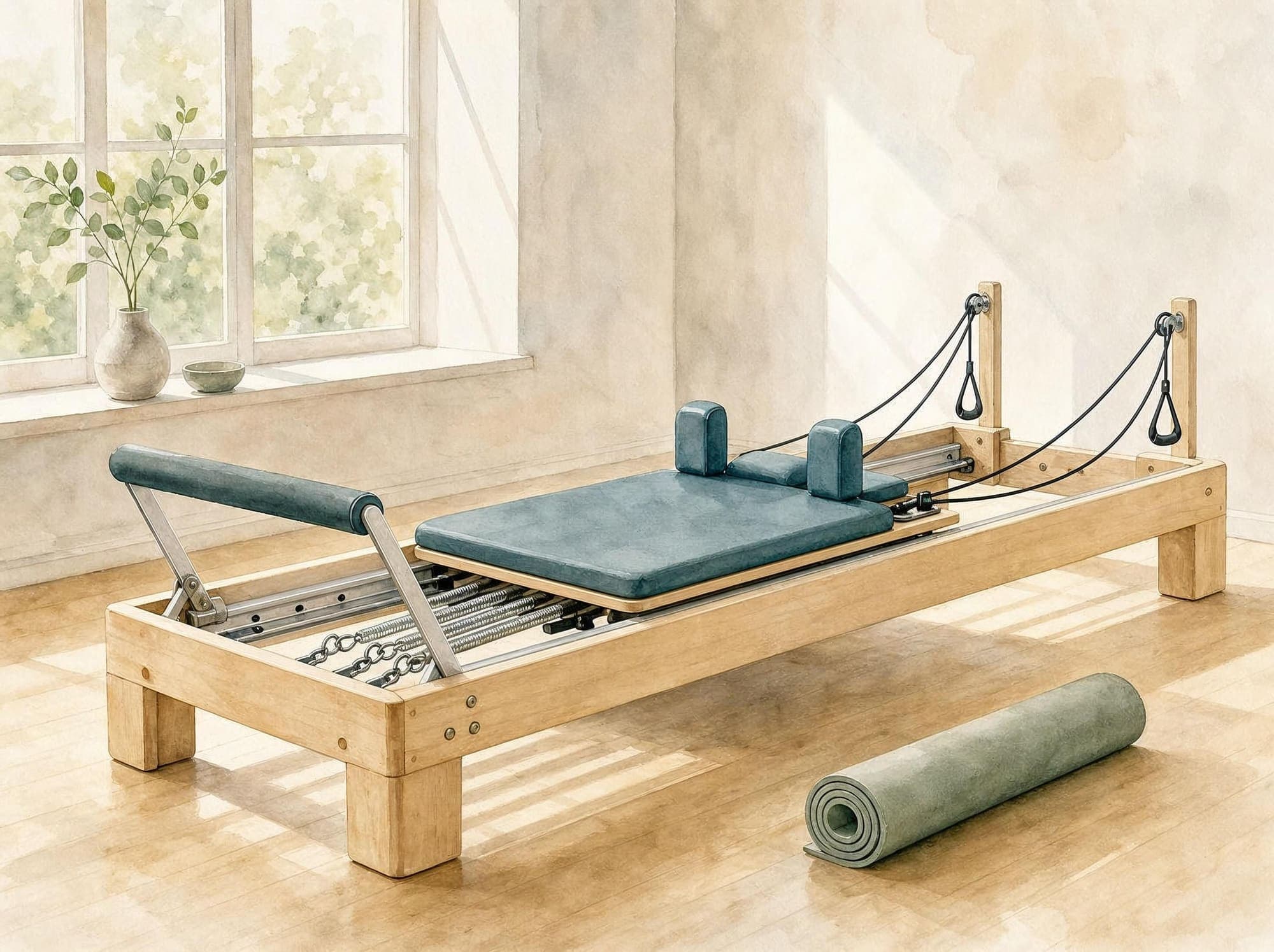
It is practised with close attention to posture, coordination and breath. The exercises take place on the mat, often with small props, or on purpose-built apparatus such as the Reformer, whose springs give resistance or support the movement.
The sections that follow cover where Pilates comes from, the core ideas of the method, the differences between yoga and Pilates, what the two share and common misconceptions.
Joseph Hubertus Pilates was born in Mönchengladbach in 1883 and took up gymnastics, boxing and other forms of physical culture early on. When the First World War began he was living in England; as a German national he was interned, including at the Knockaloe camp on the Isle of Man, where he worked on his exercises with fellow internees. The often-told story that he fixed springs to hospital beds there goes back to his own later accounts and is not documented in the surviving camp records. In 1926 he went to New York, where he ran his own studio with his partner Clara until his death in 1967.
These six terms are often used to describe the method today. Joseph Pilates himself drew up no fixed list of principles; the list comes from later accounts of his method, first a book by Philip Friedman and Gail Eisen published in 1980. Some schools name different or additional principles.
Attention rests on the movement being carried out right now.
Every movement is consciously guided, on the way back as well, and not left to momentum.
Many movements start from a stable centre of the body, often called the “powerhouse” in Pilates.
Exact execution counts for more than the number of repetitions.
The breath is matched to the sequence of movement.
The movements pass evenly into one another; the transitions are part of the exercise too.
This section distinguishes three levels: the yoga tradition as a whole, the Pilates method, and the way both are taught today. A single class only ever shows part of either.
Yoga is more than exercise or relaxation training. Depending on the tradition and the context, it includes asanas (postures), pranayama (guiding the breath), meditation and aspects of how one lives. Not every yoga class today addresses all of these areas explicitly.
In depth in the wiki: What is yoga? Meaning, origin and history
Pilates is a method in its own right, with a repertoire of exercises developed by Joseph Pilates. Today it is taught either classically, following his model, or in forms developed from it, on the mat and on apparatus.
| Yoga | Pilates | |
|---|---|---|
| Origin | Roots in Indian traditions, handed down in texts such as the Upanishads and the Yogasūtra. Many of the styles common today emerged in the 20th century. | Developed by Joseph Pilates in the first half of the 20th century, first in Europe, from 1926 in New York. |
| Aim and framework | Depending on the tradition, a comprehensive path of practice that aims at a collected mind and at insight. Physical exercises are one part of it, embedded in philosophy and a way of life. | A method for the whole body, meant to train posture, strength, mobility and coordination. Concentration is part of it; it is not bound to a religious tradition. |
| Movement practice | Asanas are held or linked in a flow. Depending on the style, the practice is calm and slow or powerful and physically demanding. | A set repertoire of exercises with few, precisely guided repetitions. It combines strength with mobility, stretching and coordination. |
| Role of the breath | The breath accompanies the asanas. In pranayama it becomes the exercise itself, often also as a preparation for meditation. | The breath is matched to every movement and is meant to support the stability of the trunk. Many schools teach breathing into the sides of the ribcage. |
| Mat and apparatus | Mostly on the mat, with a block, strap, cushion or blanket where needed. | On the mat, often with small equipment such as a ring or a ball, or on spring apparatus such as the Reformer, Cadillac and Chair. |
The table describes broad features. What a single class looks like depends on the style, the school and the teacher. More on the origin and meaning of yoga: What is yoga? Meaning, origin and history
Yoga and Pilates can both link conscious movement with attention to your own body and with the breath. Some exercises also look alike in their outer form. That does not make the two interchangeable: the same form can stand in a different context and serve a different purpose.
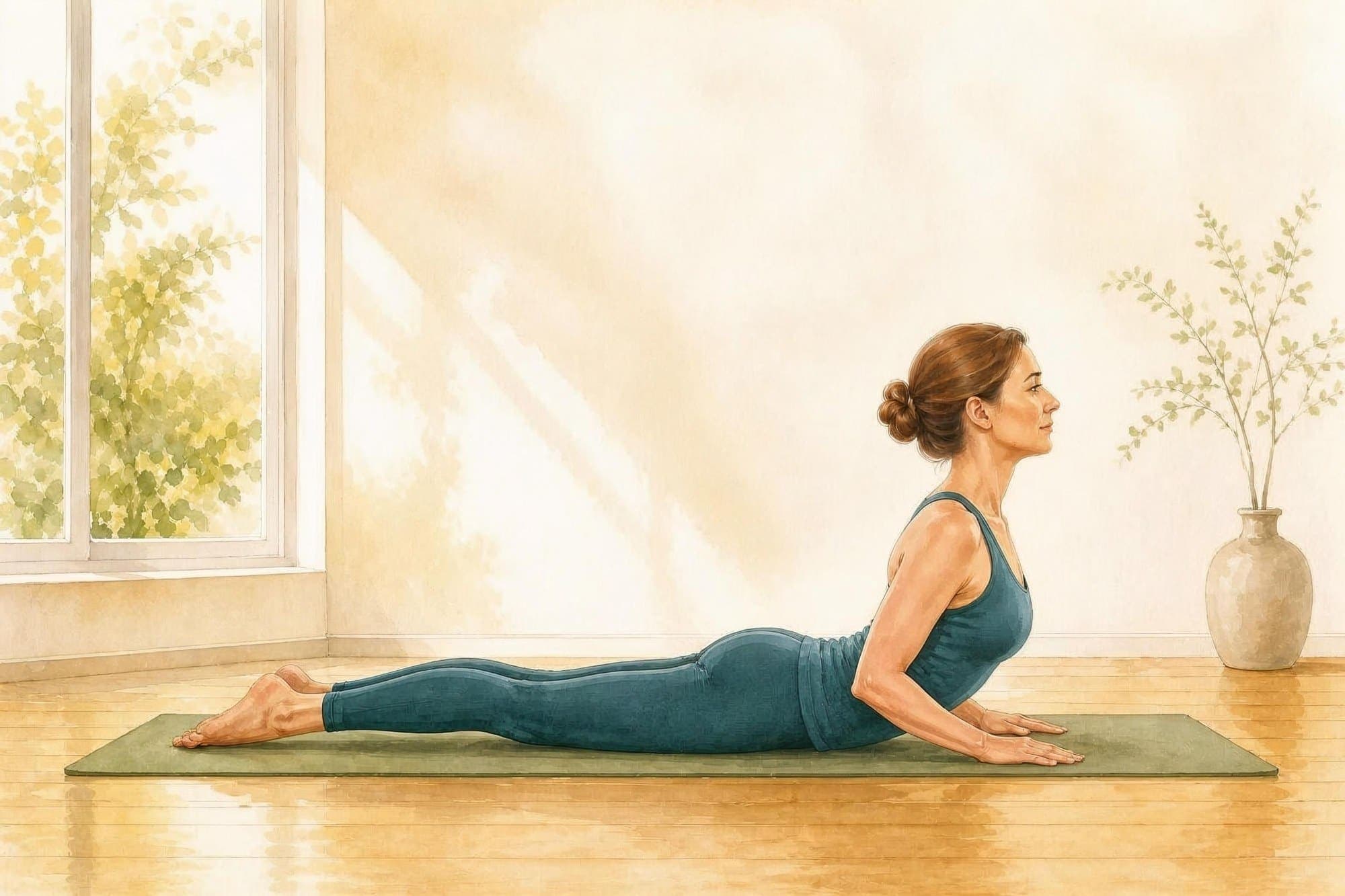
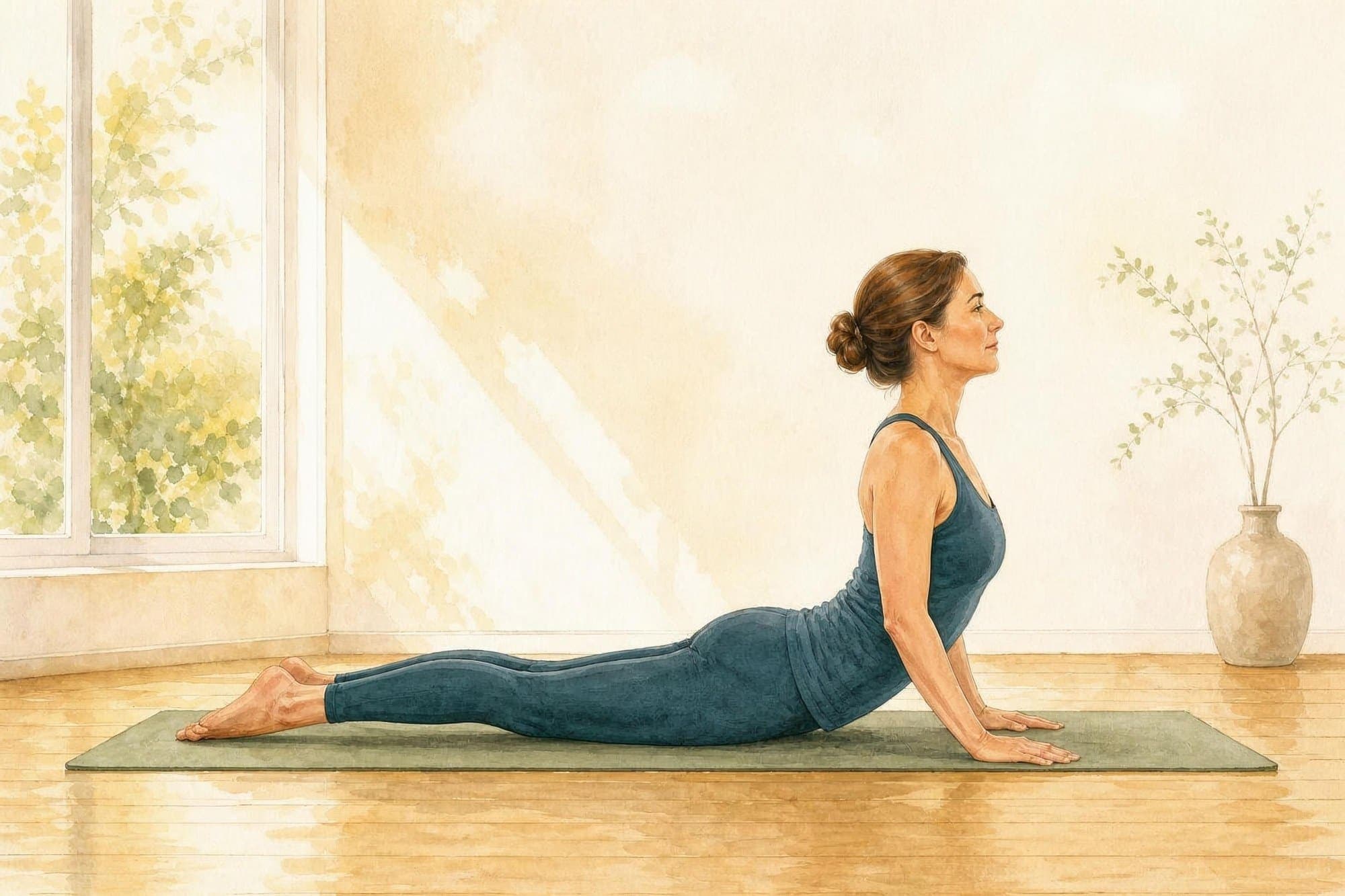
The Swan in Pilates and the cobra (Bhujaṅgāsana) in yoga can look very much alike from the outside. In the hand-supported variations shown here, the upper body is lifted from lying face down into a backbend: the back muscles work actively, the hands give support, the pelvis stays on the floor.
How much the arms help is not a clear distinguishing feature here. In a low cobra the hands help only a little; in a higher one they support more and the arms are straighter. In the Swan, too, the lift can come first from the back muscles before the hands support a higher position.
The difference shows more clearly in the sequence: the Swan is often repeated as a controlled lifting and lowering, the cobra often held for several breaths. The line is not rigid, though: a preparatory Swan can also be held, and the cobra practised in a flow.
Some widespread statements about yoga and Pilates are only partly true.
Many asanas stretch, others call for strength, balance or stamina. Postures are also only one part of yoga: depending on the tradition, breathing exercises, meditation and questions of how to live belong to it as well.
Pilates is not a variation of yoga but a method in its own right, with its own history, its own exercises and its own core ideas. Nor is the mental side missing: Joseph Pilates described his Contrology as the complete coordination of body, mind and spirit.
Both come in many tempos and intensities. Some styles of yoga are very calm, others powerful and demanding; Pilates can be practised gently and slowly or in a very challenging way. How a class goes depends on the style, the teacher and the group.
The Reformer is the best-known Pilates apparatus, but Pilates is practised on the mat just as much. Joseph Pilates himself described a sequence of 34 mat exercises in his book of 1945; he also designed other apparatus.
A class shows one part of it, often postures, breathing exercises and relaxation. Yoga as a tradition covers more, such as philosophy, ethics and different paths of practice. In the same way, a single Pilates class shows only part of the repertoire.
In our courses in Lauenburg and Witzeeze we bring together breathing exercises, asanas, relaxation and meditation. Talk to us if you would like to get to know yoga in a group.